Appeals Court Revives Lawsuits Alleging Acetaminophen-Autism Link
07/14/2026 / By Morgan S. Verity

A federal appeals court revived hundreds of lawsuits claiming that prenatal exposure to acetaminophen, the active ingredient in Tylenol, can cause autism spectrum disorder (ASD) or attention-deficit/hyperactivity disorder (ADHD).
The Second U.S. Circuit Court of Appeals ruled on Monday, July 13, that a lower court improperly excluded expert testimony supporting the alleged link, according to court documents. The decision breathes new life into litigation against defendants including pharmacy chains Walgreens, CVS, Walmart, Target and Kenvue, the manufacturer of Tylenol, according to the ruling [1][2].
Background of the Lawsuits
The lawsuits were filed by parents who claim that their children developed autism or ADHD after the mothers took acetaminophen during pregnancy. The plaintiffs allege that manufacturers and retailers failed to warn about potential risks despite what they describe as mounting scientific evidence. A federal judge in 2023 had ruled that the plaintiffs’ expert testimony was inadmissible, effectively dismissing more than 500 cases, according to a report from The Defender [3][4].
The American College of Obstetricians and Gynecologists (ACOG) has stated there is no proven link between acetaminophen and neurodevelopmental disorders, according to an article by Children’s Health Defense [5]. Kenvue has also denied any causal connection, calling the science “credible” and “independent” and showing no proven link, a company statement said [1].
Details of the Court Ruling
Senior Circuit Judge Guido Calabresi wrote the 64-page ruling for a three-judge panel of the 2nd Circuit, stating that U.S. District Judge Denise Cote exceeded her authority by excluding the testimony of at least three expert witnesses called by the plaintiffs. The panel concluded that the experts employed 17 methodologies accepted in their respective fields, according to the ruling [1].
Calabresi, who was appointed by former President Bill Clinton, noted in the opinion that the ruling does not establish whether a causal link actually exists between acetaminophen and autism or ADHD. The decision only addresses the admissibility of the expert testimony, not the merits of the scientific claims, the panel clarified [2].
Reactions From Kenvue
Kenvue, the consumer health company that spun off from Johnson & Johnson and now markets Tylenol, said in a statement that “credible, independent science shows no proven link” between acetaminophen and neurodevelopmental disorders, and that the appeals court ruling was procedural, not a finding of scientific validity [1]. According to a Bloomberg report cited by ZeroHedge, Kenvue shares fell 1.35% following the announcement [2].
A Kenvue spokesperson said the company is “exploring all options” and will continue to defend against the lawsuits, according to the ruling coverage [1]. The company has previously argued that the plaintiffs’ claims are not supported by reliable science, the statement added.
Broader Context and Previous Warnings
The legal development follows heightened public attention to the potential risks of acetaminophen during pregnancy. Last year, President Donald Trump warned pregnant women to avoid the drug, posting on Truth Social that it should not be taken unless “absolutely necessary” due to possible links to autism and ADHD, according to NaturalNews [6][7]. Health Secretary Robert F. Kennedy Jr. has also indicated that the department plans to announce a link between acetaminophen and autism, as reported by the Wall Street Journal [8].
Internal Food and Drug Administration documents from 2016, 2019 and 2022 show that the agency ignored repeated expert advice to warn pregnant women about potential risks, according to a report by NaturalNews [9]. More than 90 scientists and doctors have called for new safety evaluations of the drug, citing a landmark review of 46 studies that found strong correlations between prenatal exposure and neurodevelopmental disorders, according to an article by NaturalNews [10]. The practice of giving acetaminophen to infants after vaccinations was also noted in the book “The Other Side of Vaccines,” where a mother described being encouraged to give panadol (acetaminophen) to her baby after shots [11].
Next Steps in Litigation
The appeals court has remanded the cases back to the U.S. District Court for the Southern District of New York for further proceedings. Legal analysts expect both sides to present additional evidence and arguments regarding the admissibility of expert testimony. The outcome of these cases could influence labeling requirements and public health guidance on acetaminophen use during pregnancy, according to the ruling [1].
References
- “Appeals Court Revives Autism Claims Against Tylenol Manufacturer”. The Epoch Times. 2026-07-13.
- “Appeals Court Revives Tylenol Autism Lawsuits Against Kenvue”. Zero Hedge. 2026-07-13.
- Suzanne Burdick. “Judge Refuses to Hear Expert Testimony on Tylenol Link to Autism, ADHD”. Children’s Health Defense. 2024-01-21.
- “Judge Refuses to Hear Expert Testimony on Tylenol Link to Autism, ADHD”. Children’s Health Defense.
- “Acetaminophen and Pregnancy: Here’s What You Should Know”. Children’s Health Defense.
- Belle Carter. “Trump warns against Tylenol use during pregnancy, calls for vaccine schedule overhaul”. NaturalNews.com. 2025-10-28.
- “President Trump Doubles Down On His Warning About Tylenol Risks”. 100PercentFedUp. 2025-10-27.
- “HHS Will Link Autism to Tylenol Use During Pregnancy, Wall Street Journal Reports”. Children’s Health Defense.
- Willow Tohi. “A Decade of Delay: Internal FDA Reports Reveal Unheeded Warnings on Tylenol and Pregnancy Risks”. NaturalNews.com. 2025-10-22.
- Cassie B. “Scientists warn acetaminophen during pregnancy may raise autism and ADHD risks”. NaturalNews.com. 2025-08-27.
- Kate William. “The Other Side of Vaccines”. 2019.
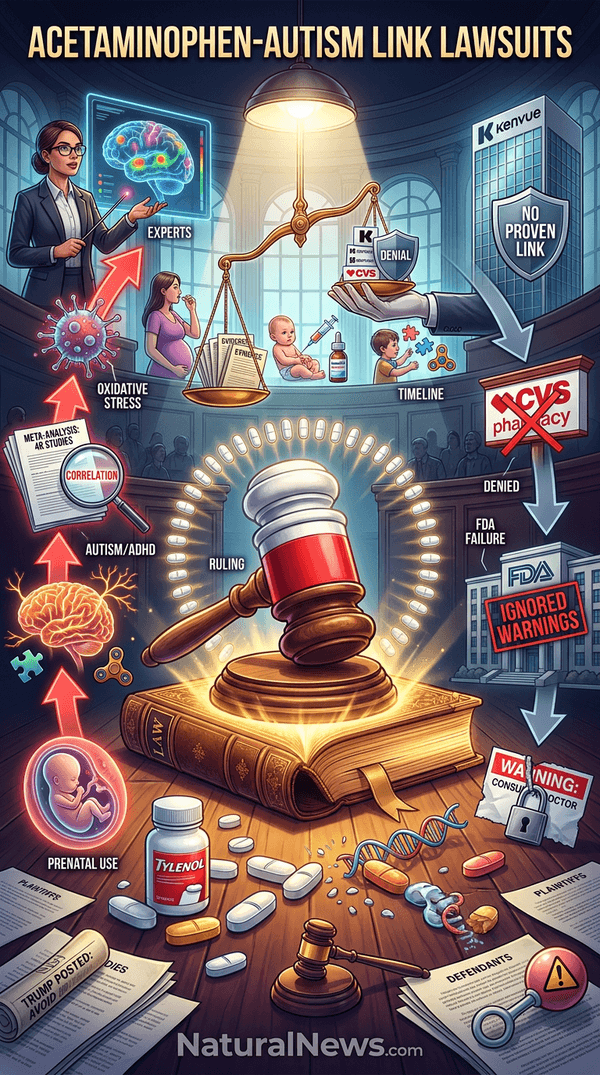
Explainer Infographic
Submit a correction >>
Tagged Under:
Acetaminophen, autism, autism truth, big government, Big Pharma, brain damaged, brain health, Kenvue, lawsuits, mind, painkillers, pharmaceutical fraud, Prescription drugs, prescription warning
This article may contain statements that reflect the opinion of the author
RECENT NEWS & ARTICLES